AWARE · Case study
Service design · UX research · Civic tech · Prototype

The missing half of India's e-challan system.

India can issue a traffic challan in seconds. Resolving one can take a citizen days, if they ever find it. AWARE is a service design proposal that reaches drivers where they already stop, proves the challan is real, and gives them one clear path to pay or dispute.

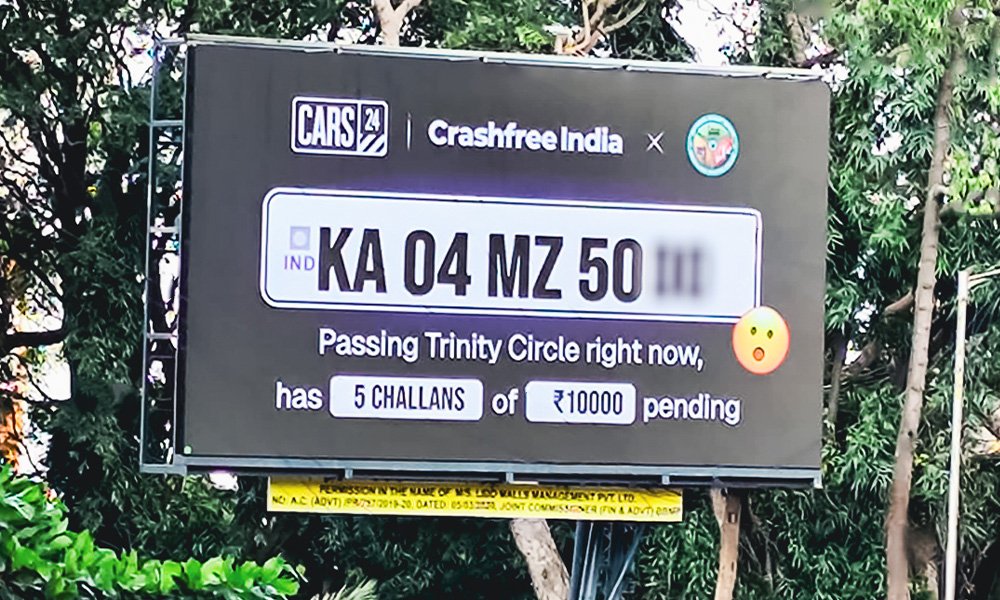
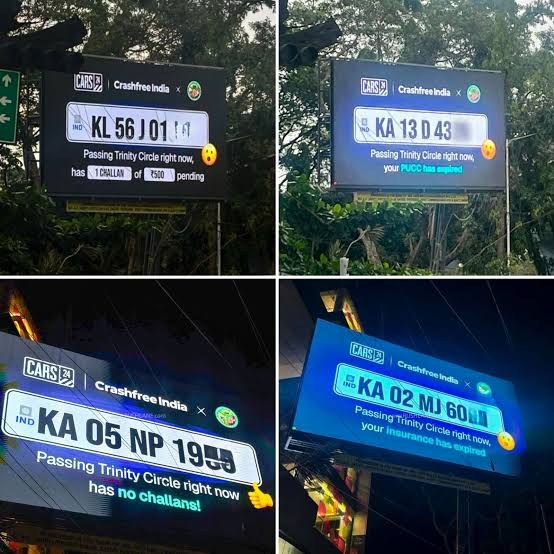
AI billboard in Bengaluru showing a vehicle's number plate and its pending traffic fines
What exists today: an AI billboard in Bengaluru (Cars24 × Crashfree India, Sept 2025) reads plates and shows pending fines to everyone passing the junction.
Role
Service & UX Researcher, UX Designer
Timeline
Jan – May 2026 · 5 months
Context
Solo academic project, UPES Dehradun
Output
Research, service system, UI, working ANPR prototype
Four billboard states: one challan of 500 rupees pending, PUC expired, no challans, and insurance expired, each above a vehicle's number plate
The gist

A camera reads your plate at a junction. A billboard shows it, with what you owe, to everyone around you.

  • 1 challan · ₹500 pending
  • PUC has expired
  • Insurance has expired
  • No challans 👍

The technology to find a pending challan and show it at the roadside already exists. What's missing is everything after that: a notice people can trust, evidence they can check, privacy, and a clear way to pay or dispute. That's what AWARE designs.

Photos: Cars24 × Crashfree India campaign, Trinity Circle, Bengaluru, 2025 (plates partly blurred at source). Via Media4Growth and social media.

02Project snapshot
Team

Solo, under the guidance of UPES faculty Rakesh Ahriwar and Abhjeet Raut

My contribution

End to end: research, synthesis, concepts, service design, UI, usability testing and the working prototype

Methods

Interviews · Contextual inquiry (think-aloud) · Field observation · Stakeholder interviews · Benchmarking · Service blueprint · Physical prototype

Tools

Google Colab (Python, AI-assisted) · Spreadsheet database · Twilio (SMS) · Webcam, laptop, 2 phones · Figma · Miro

Research scope

12 interviews · 6 contextual inquiries · 3 intersections · Police, RTO and smart-city stakeholders · 5 international systems

Geography

Delhi-NCR, Bihar, Uttar Pradesh, with further input from Bengaluru, Hyderabad, West Bengal, Jharkhand, Maharashtra

Focus

Trust · Discoverability · Payment certainty · Dispute access · Privacy

Deliverables

Ecosystem map · Journey map · 4 concepts · Service blueprint · Failure-recovery design · Flows · Toll & receipt UI · Prototype

03The problem

Enforcement scaled. Resolution didn't.

India's e-challan system is technically impressive. ANPR cameras read a plate, VAHAN finds the owner, and a challan is generated automatically.

Yet most challans are never resolved. Of 5.16 crore challans issued in 2025, 64.1% were still pending (Cars24 data analysis, 2026). I followed a challan from the camera to the citizen. The system works perfectly until the challan leaves the government's systems.

  • 01
    It arrives as an SMS that looks like a scam.No verified sender, no photo, no location, just an amount and a link.
  • 02
    It may never arrive at all.The number on file can be years old, and SMS is the only channel.
  • 03
    It lives on one of 28+ state portals.A challan issued outside your home state doesn't show up on your home state's portal.
  • 04
    Payment has no confirmation.Money can leave your account while the challan still says pending.
  • 05
    Disputing means a police station.The digital dispute path isn't in the main interface.
Detect

ANPR, RLVD and speed cameras; officer handhelds

Identify

VAHAN owner lookup; evidence attached

Generate

Challan written to the state database

×
Notify

One unverified SMS to a possibly outdated number

×
Resolve

28+ portals, unconfirmed payments, offline disputes

×
Escalate

Penalties, summons, blacklisting, often unseen

━ Works for the state┅ Breaks for the citizen
Problem statement

Private vehicle owners in India have to deal with a fragmented, semi-centralised enforcement system. Challans are hard to trust, hard to find, and hard to resolve with confidence. Unpaid challans are usually read as a compliance failure. My research suggests they're mostly a failure of awareness, trust and service design, sitting on top of infrastructure that already works.

04Why this matters

People aren't ignoring challans. They're being careful.

Research finding
8/12
interviewees distrusted or delayed acting on the challan SMS.
In an inbox full of phishing, treating an unverified payment link with suspicion is the correct behaviour.
Research finding
4.2
portal visits on average before participants found the right challan page.
From 6 think-aloud sessions. If you check the wrong portal and see nothing, you reasonably assume there's nothing to pay.
System analysis
1
notification channel: SMS, with no fallback when it fails.
Outdated numbers, spam filters and dismissed messages all end the same way: the citizen never finds out.

This is also a road-safety issue. A challan exists to deter speeding, signal-jumping and riding without a helmet. A challan that is never trusted, found or resolved deters no one.

05The human side

Four behaviours, not four demographics.

From the interviews and inquiries, four patterns kept coming up. Each one wants to comply, and the system gives each one a different reason not to.

Segment 01

The unaware

“If it's important, someone will tell me properly.”
Behaviour
Ignores the SMS; finds out at a police stop or RC renewal
What breaks
Penalties grow unseen
Needs
A trusted alert at the right moment
Segment 02

The anxious payer

“Payments are risky unless confirmed.”
Behaviour
Pays promptly, then double-checks
What breaks
A failed gateway leads to double payments
Needs
Instant, clear confirmation
Segment 03

The outstation driver

“If it's not on my portal, it doesn't exist.”
Behaviour
Checks only the home-state portal
What breaks
Other states' challans stay invisible
Needs
One view across every state
Segment 04

The sceptic

“If I can't verify it, I won't trust it.”
Behaviour
Doubts accuracy; avoids digital disputes
What breaks
Ends up at a police station
Needs
Visible evidence and a clear dispute path

The quoted lines are synthesised from interview patterns, not verbatim quotes.

06Research

I used each method to answer one question, and each one changed the design.

Interviews

12 private vehicle owners with a challan in the past 12 months, covering paid, pending and disputed challans
Why
To understand behaviour and emotion around a real challan
Learned
Distrusting the SMS was the norm, not the exception
Changed
Trust became the first design problem, not the last

Contextual inquiry

6 think-aloud sessions on the Parivahan e-challan portal
Why
To see where people actually got stuck
Learned
4.2 portal visits on average; evidence images were small and buried
Changed
One vehicle-number search; evidence at the top of the challan

Field observation

3 urban intersections; CCTV and ANPR infrastructure
Why
To see where the system physically meets drivers
Learned
Where cameras sit, and how drivers react
Changed
Awareness could happen at physical infrastructure, not only on a phone

Stakeholder interviews

2 traffic police officers · 1 RTO official · a smart-city operations team
Why
To understand the backstage
Learned
Gaps in state-to-national sync, offline handheld devices, limited cross-state visibility
Changed
Aggregate the state data instead of centralising it, and show how fresh it is

Benchmarking

4 Indian portals · Singapore, UK, New South Wales, UAE, Estonia
Why
To find proven patterns
Learned
The systems benchmarked send evidence with the notice and verify the sender through a trusted identity
Changed
Evidence thumbnails; a DigiLocker-linked verified notice

Ecosystem mapping

Stakeholders across national, state and technology layers
Why
To find where the handoffs fail
Learned
Detection works; the citizen-facing service layer was never designed as a whole
Changed
The brief moved from "redesign the app" to "design the service"
07Key insights

Five questions every driver is actually asking.

01

“Is this even real?”

Research finding
Evidence

8 of 12 interviewees distrusted or delayed acting on the challan SMS. It has no verified sender and no context.

Meaning

This isn't low literacy. It's learned scam-avoidance, applied to a message that looks like a scam.

Design implication

The notice must prove it's official before it asks for anything.

02

“Where is my challan?”

Research finding
Evidence

An average of 4.2 portal visits. Outstation challans didn't show on home-state portals, and stakeholders confirmed sync delays.

Meaning

Much of what looks like non-payment is really non-discovery.

Design implication

One search by vehicle number, covering every state.

03

“Is this actually my vehicle?”

Research finding
Evidence

Evidence sat 3–4 screens deep, small and heavily compressed. Stakeholders described ANPR misreads (0/O, 1/I, 8/B).

Meaning

People can't judge a challan they can't see.

Design implication

Show the evidence first: full size, labelled with place, date and violation.

04

“Did my payment go through?”

Research finding
Evidence

After a failed payment, people called their bank, retried, and saved screenshots as proof. Messages like “your vehicle may be blacklisted” made it worse.

Meaning

One bad payment teaches people to avoid the system, or to pay in person.

Design implication

Live payment status, instant closure, and a failure state that says plainly that no legal action applies.

05

“What if it's wrong?”

Research finding
Evidence

The dispute flow wasn't in the main interface. People who wanted to dispute had to visit a police station.

Meaning

A lost working day and an informal process with no record breed institutional distrust.

Design implication

Dispute sits next to Pay, at equal weight.

The insight under all five

VAHAN, SARATHI, Parivahan, UPI, DigiLocker and FASTag already exist and work. The technology is there. What's missing is a service that ties it together: an orchestration gap.

08User journey

The lowest point isn't getting the challan. It's paying and not knowing if it worked.

Notification
Discovery
Verification
Decision
Payment ⚠
Payment failure ⚠
Resolution
Emotion
calm panic
Doing
Gets an SMS with an amount and a link
Tries several portals
Opens the challan, screenshots it
Weighs paying against disputing
Enters details very carefully
Calls the bank, retries
Checks the portal again and again
Thinking
“Is this a scam?”
“Which site is the real one?”
“Is that even my car?”
“If I disagree, what then?”
“Don't fail. Don't double-charge.”
“Money's gone, challan's still here.”
“Is it really closed?”
Feeling
Confused, distrustful
Frustrated
Mildly anxious
Helpless
Guarded hope
Panic
Delayed, partial relief
Pain point
No verified sender; no evidence
28+ portals; no redirect
Small, unlabelled evidence
No visible dispute path
No progress indicator
No reconciliation; legal threats unchanged
No closure confirmation
Opportunity
Verified notice with photo and case number
One vehicle-number search
Full-size, labelled evidence first
Pay and Dispute at equal weight
Live status during processing
“Not charged. No legal action applies.”
Push / SMS when closed
Scroll sideways to see the full journey →

Emotion levels and thoughts are qualitative, synthesised from interviews and journey mapping.

09The opportunity
How might we

…help a driver find out about a challan, trust it, and resolve it, without replacing the state systems that can't be centralised?

ProblemInsightOpportunityPrinciple
The SMS looks like phishingDistrust is rational cautionMake the notice verifiable on its faceVerifiable before actionable
Evidence is buried and blurryPeople can't judge what they can't seeEvidence at first viewEvidence first
Dispute means a police stationA hidden dispute path breeds distrustDispute next to PayPay and dispute are equals
Payment status unknownUncertainty, not indifference, drives avoidanceAlways show where things standNever leave status unknown
Drivers don't visit portalsAwareness has to come to themUse places they already stopMeet people where they are, privately
28+ separate portalsNon-payment is often non-discoveryOne search across all statesOrchestrate, don't replace
10Design principles
  1. Verifiable before actionable

    Prove the challan is official before asking for anything.

  2. Evidence first

    Answer “why did I get this?” before “how do I pay?”

  3. Pay and dispute are equals

    Same size, same weight, same screen.

  4. Never leave status unknown

    Every state, including failure, gets plain-language copy and a next step.

  5. Meet people where they are, privately

    Awareness can be public; details stay private.

  6. Orchestrate, don't replace

    Build on VAHAN, Parivahan, DigiLocker, UPI and FASTag, and keep SMS as the baseline.

11Exploration

The answer wasn't obvious. I explored four directions.

Each concept started from a different part of the problem, and each fixed something the others missed.

Core
A
ChallaNSafe · Notification first
If people trust the notice, they'll engage.

A verified SMS or WhatsApp notice with a government seal, an evidence thumbnail, and one link into a unified portal.

+ Solves trust and fragmentation together
− Still depends on people engaging with a notification

B
ChallanBoard · Dashboard first
Constant visibility ends “I didn't know”.

An IRCTC-style tracker showing every challan and its live payment status.

+ Reduces payment anxiety
− Someone who distrusts the SMS never installs the dashboard

Recovery
C
ChallaNAid · Dispute first
Never leave anyone unsure of the next step.

A guided wizard: is this your vehicle? → evidence → Pay or Dispute, at equal weight.

+ Makes disputes far easier to file
− Doesn't fix the entry point

Awareness
D
Ambient · City as notification
Awareness should happen where drivers already are.

Screens at tolls, pumps and parking show a masked, minimal alert when ANPR finds a pending challan.

+ Reaches people without smartphones
− A privacy risk if poorly governed

How I chose

No concept scored well everywhere. A was strongest on trust and discovery but weakest on reach, and D was the reverse. So I combined them: A is the core, D is the awareness layer, and C's dispute wizard handles recovery.

These are my own ratings, used to compare concepts. They are not user-validated.

CriterionABCD
Prototype result

Iteration: the toll display.

A driver reads a toll screen in a few seconds, while moving. My first version showed every system state at once. Testing showed that didn't work.

Before · states shown at oncev1
Welcome to toll plaza
Stop
Car / Jeep
HR XX XX 1234
Verifying
Challan found
No challan
4 pending
Toll deducted
Alert sent
Toll deducted
Go
After · one state, one actionv2
Before
Plate, vehicle class, verifying, found / not found, pending count, toll deducted, alert sent and GO, many of them on screen together.
Problem
The 4-person test found ambiguous messaging, no actionable next step, high cognitive load and poor feedback visibility. Edge-case review added one more risk: reading GO as “no problem”.
Change
A linear sequence: detected → checking → one result → count and amount → link sent + QR → GO.
What I learned
At the speed of a toll lane, a display can hold one state and one action. Everything else goes to the phone.
12The solution

AWARE isn't an app. It's a layer that connects systems India already runs.

For private car and two-wheeler owners. How: it detects a vehicle where it already stops, sends a notice that can be verified, shows the evidence first, and resolves the challan through payment or dispute. It builds on existing government infrastructure, with no new database.

Layer
What it does
Built on
01Ambient awarenessAlerts drivers at tolls, pumps and parkingANPR · FASTag · existing screens and receipt printers
02Verified notificationA notice that proves it's officialDigiLocker · SMS · WhatsApp
03Unified discoveryOne vehicle-number search across all statesParivahan · 28+ state databases
04Evidence & transparencyThe photo and its context, firstExisting ANPR / CCTV evidence
05Payment confidenceLive status and instant closureUPI · reconciliation ledger
06Dispute recoveryA guided digital dispute with a visible SLAState enforcement back offices
Today
With AWARE
Finds out at a police stop or RC renewal
Finds out at the next toll, pump or parking exit
An unverified SMS
A notice with a seal, a photo and a checkable case number
Guesses which portal to use
Searches once, by vehicle number
Hunts for the evidence
Sees the evidence first
Payment in limbo
Paid, processing or failed, always in plain words
Disputes at a police station
Disputes online, with the SLA shown up front
13Key experience

Receive → Verify → Understand → Decide → Resolve.

01Receive
9:41●●● ▮
9:41
Tuesday
GOIParivahan · DigiLockernow
Verified Government Notice
Traffic challan issued
Signal jumping · DL 1C AB 1234
₹ 1,000
Case no. DL-2026-000000
View detailsPay now

A verified notice: seal, badge, evidence thumbnail and case number. No threats, and two equal options.

02Verify
9:42●●● ▮
GOIIs this notice genuine?
Verified Government Notice
Issued by
Delhi Traffic Police
Case no.
DL-2026-000000
Vehicle
DL 1C AB 1234
Sender
DigiLocker · verified
Still unsure?
Enter the case number at echallan.parivahan.gov.in. It will show the same challan.
Report as fakeOpen challan

Every trust signal can be checked independently, including offline via the case number.

03Understand
9:42●●● ▮
ChallanPending
Signal jumping
Violation code · sample data
When
12 Mar 2026, 18:42
Where
Sample junction, Delhi
Vehicle
DL 1C AB 1234
Authority
Delhi Traffic Police
Amount · due in 60 days₹ 1,000
DisputePay

The evidence comes first, auto-zoomed to the plate, so the driver sees why before how to pay.

04Decide
9:43●●● ▮
Dispute · step 1 of 6
Is this your vehicle?
Yes, it's mine
No, not my vehicle ●
Not sure
Response within 5 working days. Your challan is paused while we review it.

Disputing is as easy as paying. The SLA appears before the driver commits.

05Resolve
9:44●●● ▮
Challan statusPaid
  • Issued12 Mar · Delhi Traffic Police
  • Payment receivedUPI · ₹ 1,000
  • Challan closedConfirmation sent by push and SMS
Receipt
RCPT-000000
Download receipt

Closure is pushed to the driver, so they never have to check a portal to find out.

Design Screens built from the AWARE specification using sample data. The mobile flows are designed but not yet usability-tested.
14Feature stories
Story 01Prototyped · tested with 4 drivers

Awareness at the point of contact

Problem

Most drivers never check a portal. They find out at a police stop or RC renewal, when the penalties have already grown.

Design response

Use places drivers already stop. ANPR reads the plate at a toll, pump or parking exit, the system checks for pending challans, and the driver gets a short alert with a private way to act: a 126 × 195 cm toll display, or a line and QR code on an 80 mm pump receipt or parking ticket.

The prototype

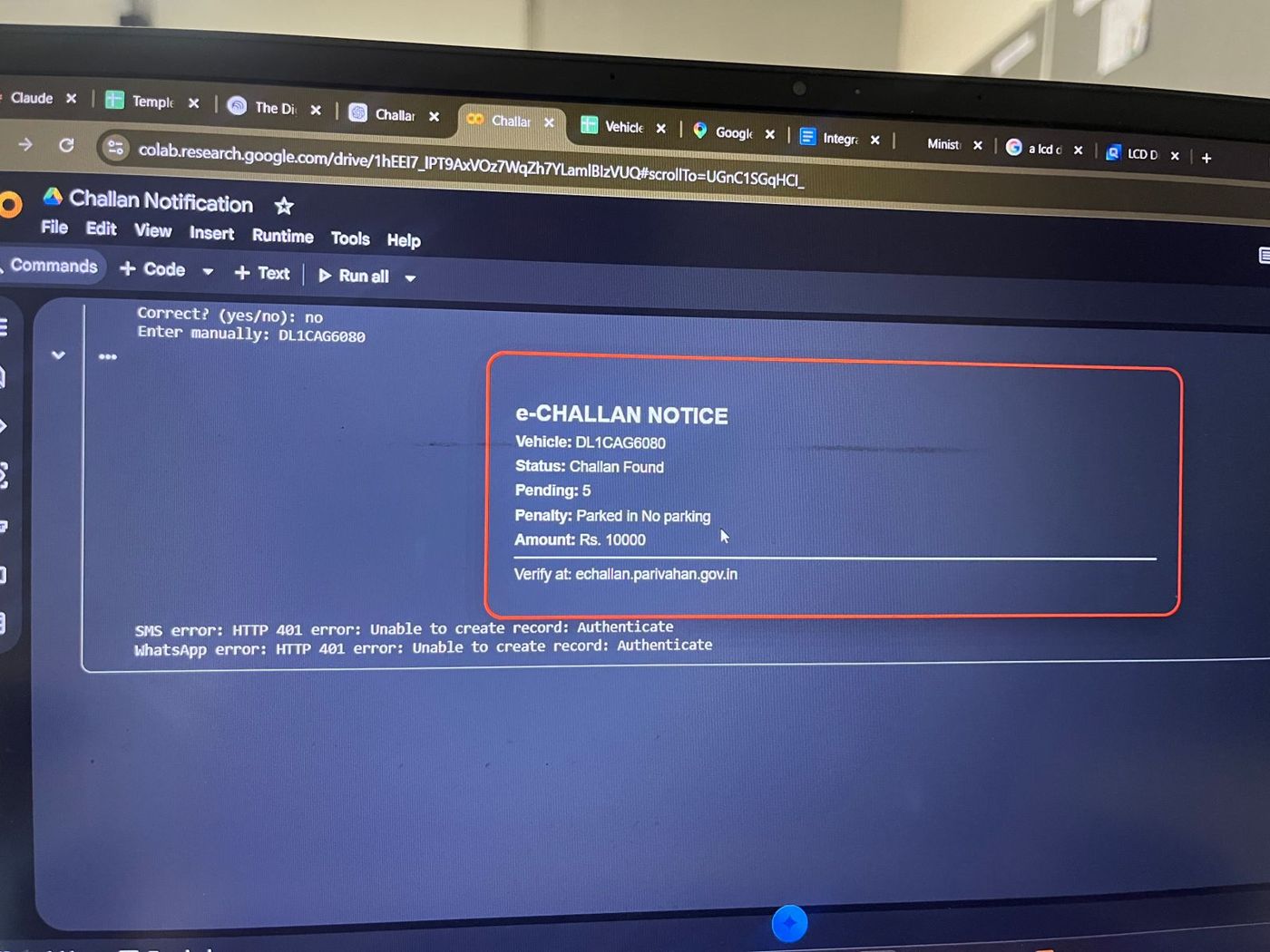
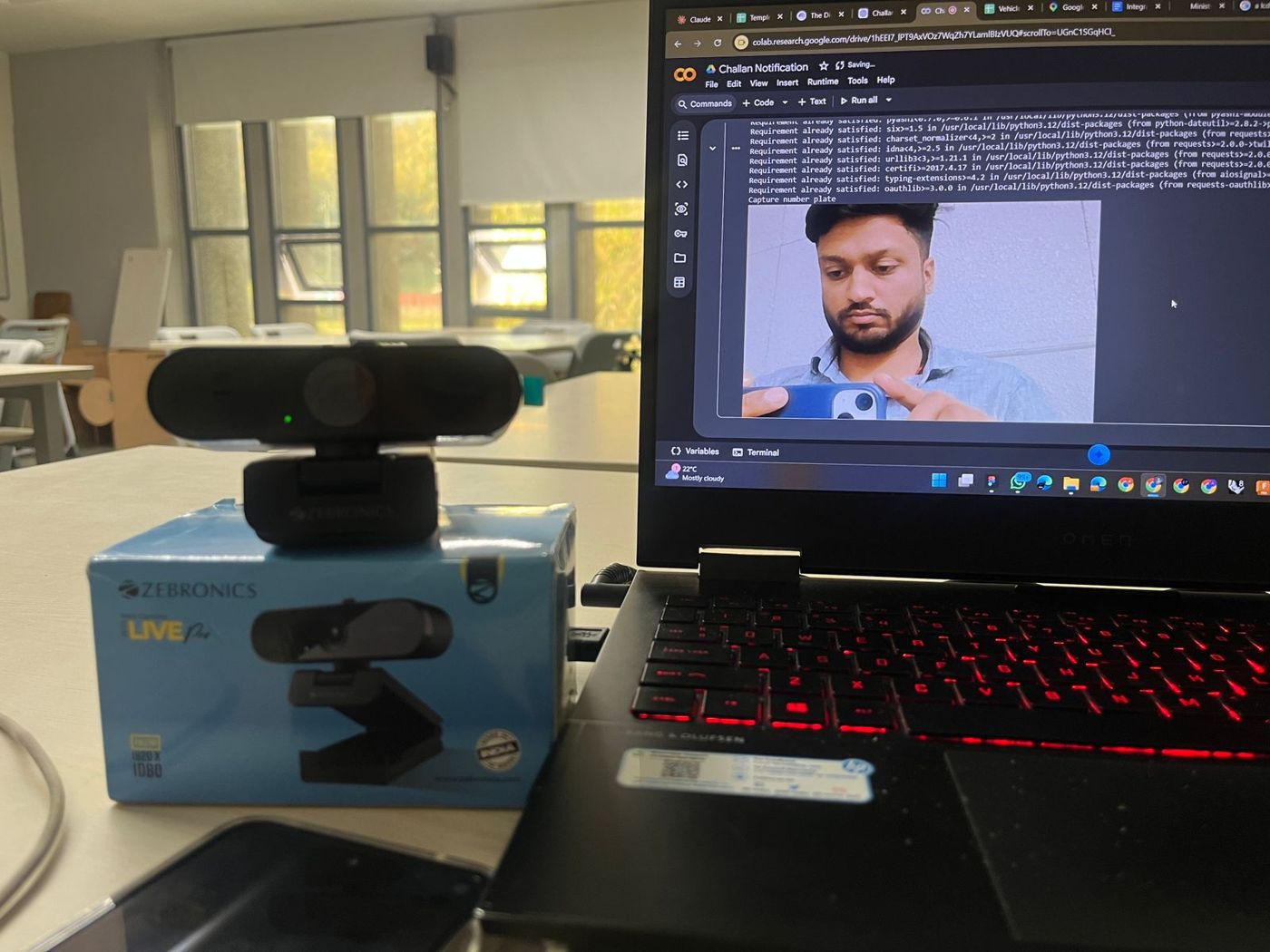
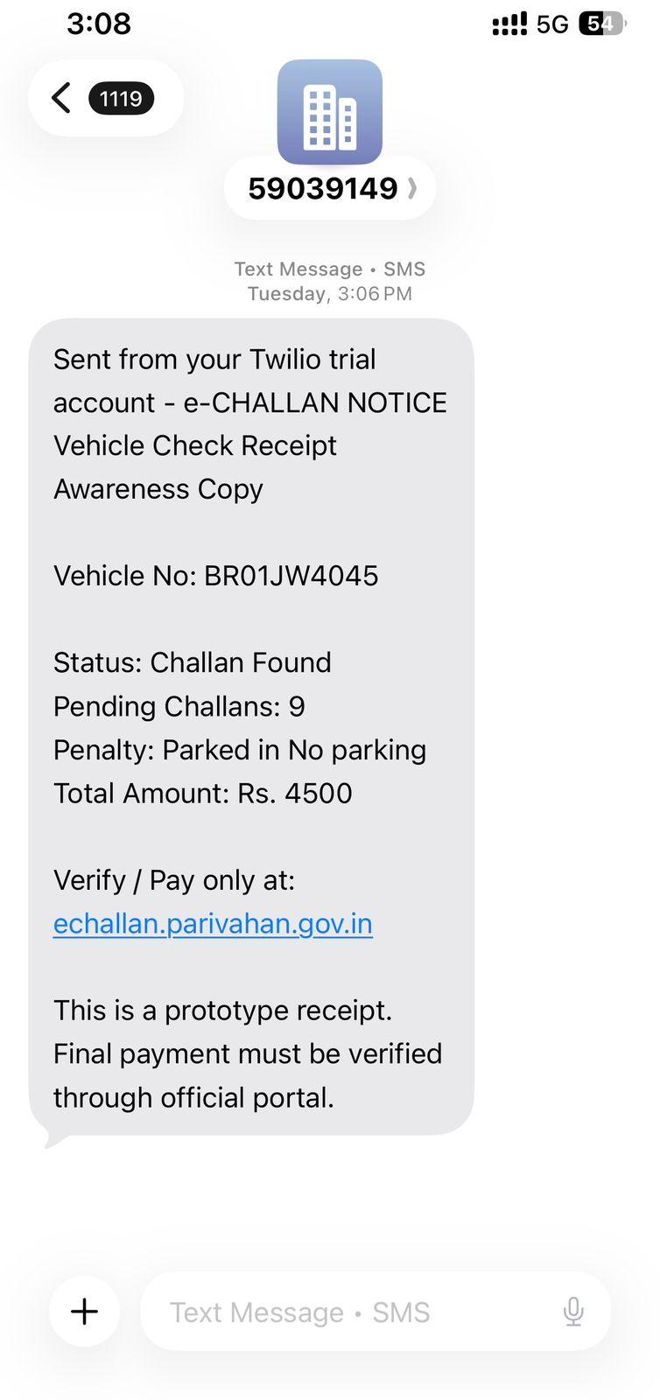
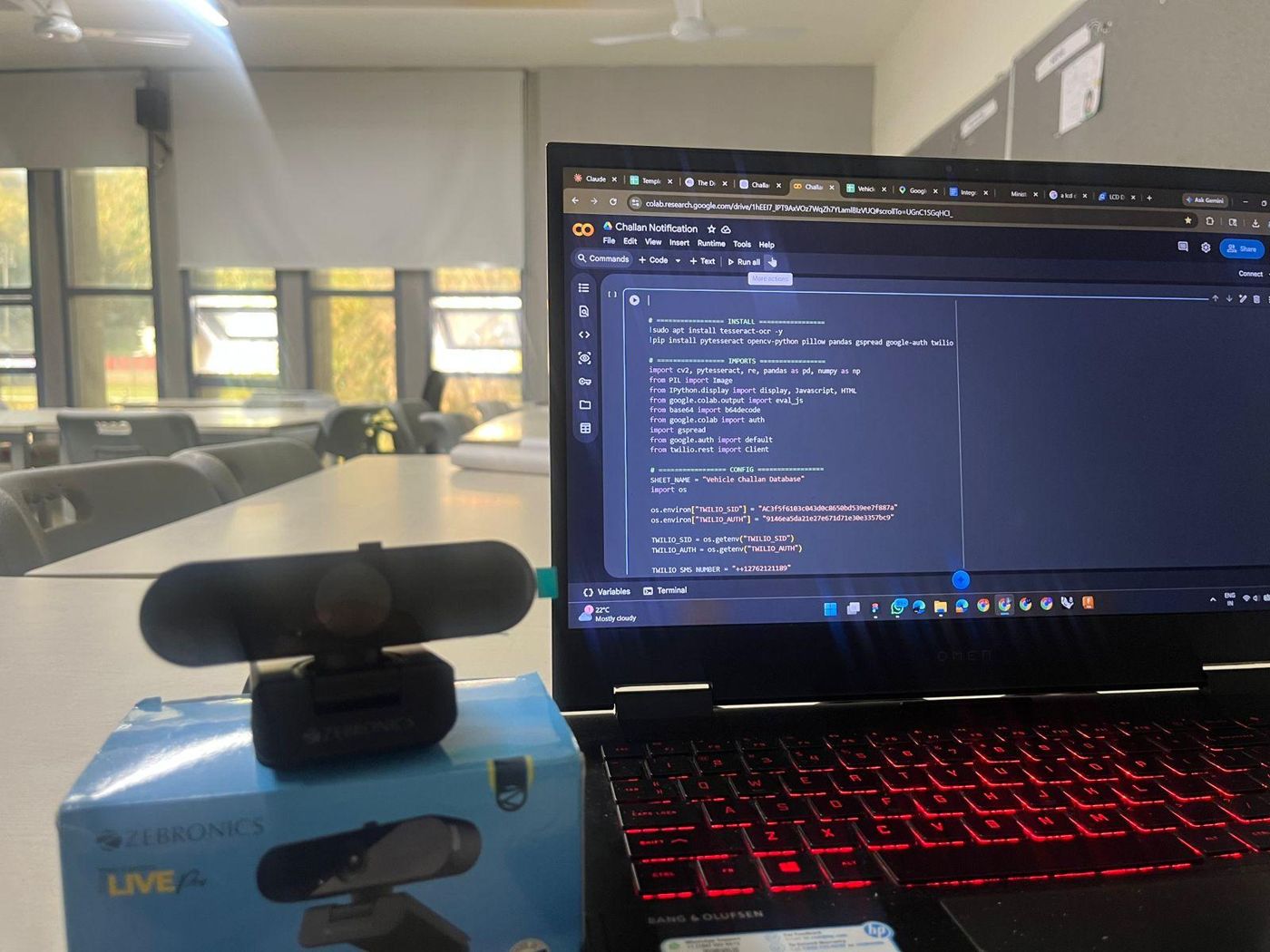
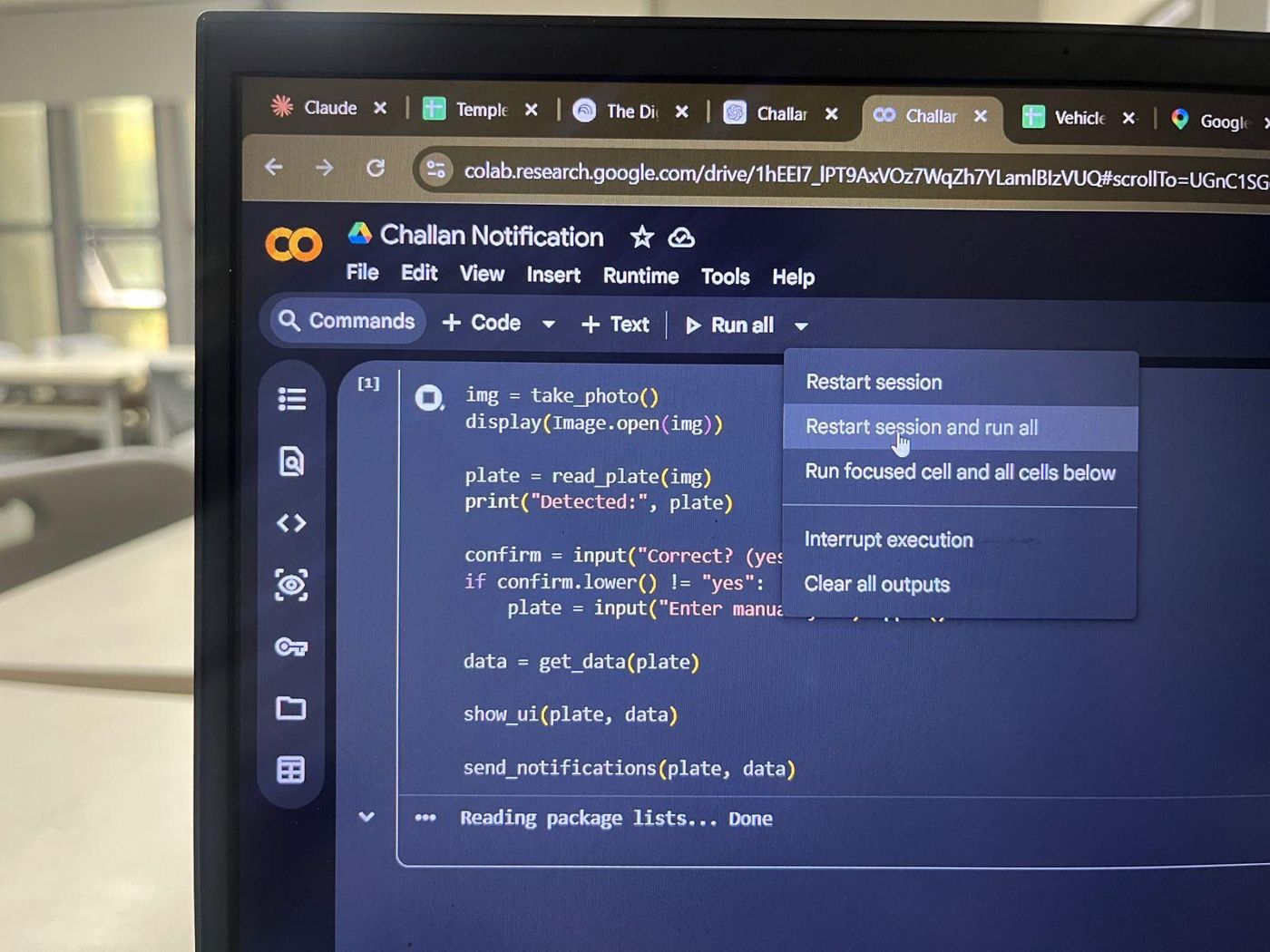
A webcam and laptop ran plate recognition in Google Colab (built with AI assistance) against a mock challan spreadsheet. When a pending challan was found, it sent a real notice by SMS through a Twilio trial account. If the plate reading was wrong, the operator could confirm or correct it by hand, which is exactly the ANPR misread problem the research flagged.
Privacy rule for public screens: masked plate (e.g. MH02**1234), no violation type, no owner name, and details only on a private channel.
Webcam mounted in front of a laptop running the plate recognition prototype
A handwritten test number plate being read by the webcam
Colab output showing an e-challan notice after manual plate correction
Mock vehicle challan database in a spreadsheet
The working prototype. The plate is read, checked against the mock database, and a notice is generated. Where the reading was wrong, the operator corrected it by hand.
SMS received on a phone: e-challan notice sent from a Twilio trial account
CITY FUEL STATION
Receipt · Pump 04

Petrol .......... ₹ 500.00
Paid by UPI
NOTICE
Vehicle MH02**1234 has
a pending challan.
Scan to view privately.
Masked plate · no amount shown
Left: the SMS the prototype actually sent. Right: the 80 mm receipt concept, redrawn for this page.
Story 02Designed · not tested

Trusted notification

Problem

A challan SMS can't be told apart from phishing, so careful people ignore it.

Design response

Four trust signals, each answering a specific doubt, appear before any call to action. The notice carries the vehicle number, place, date and amount. There's no threatening legal language at this stage.

Rationale. A generic scam can't fake a photo of your car or a case number that checks out on the official portal. Trust comes from what can be verified, not from how official the notice looks.
1
Government seal“Who sent this?” The DigiLocker header many people already recognise.
2
Verified badge“Is the sender real?” A clear label next to the sender.
9:41●●● ▮
9:41
Tuesday
GOIParivahan · DigiLockernow
Verified Government Notice
Traffic challan issued
Signal jumping · DL 1C AB 1234
₹ 1,000
Case no. DL-2026-000000
View detailsPay now
1234
3
Evidence thumbnail“Is this about me?” A generic phishing message can't show your own vehicle.
4
Case reference“Can I check it elsewhere?” It can be verified on Parivahan, even offline.
Story 03Designed · not tested

Evidence-first challan

Problem

The evidence sat 3–4 screens deep, small and blurry, so people couldn't tell whether a challan was even theirs.

Information hierarchy
  1. Evidence photo: full size, auto-zoomed to the plate, labelled with place, date and violation
  2. Violation type and code
  3. Date, time and location
  4. Vehicle number
  5. Issuing authority and case reference
  6. Amount, deadline and late-fee counter
  7. Pay and Dispute, side by side, at equal size
Rationale. The evidence is how a driver catches an ANPR misread (0/O, 1/I, 8/B). AWARE can't fix camera accuracy, but it can make errors easy to spot and quick to challenge.
9:42●●● ▮
ChallanPending
Signal jumping
Violation code · sample data
When
12 Mar 2026, 18:42
Where
Sample junction, Delhi
Vehicle
DL 1C AB 1234
Authority
Delhi Traffic Police
Case
DL-2026-000000
Due in 60 days · late fee after₹ 1,000
DisputePay
17
Story 04Designed · not tested

Payment: never leave money in limbo

Problem

A failed gateway, money gone and the challan still pending, plus a message about blacklisting. That's the lowest point of the whole journey.

Flow

Native UPI → a progress indicator the whole time → instant closure, or an honest failure state. Behind the screen, a reconciliation ledger matches payments to challans and refunds duplicates automatically.

Rationale. The copy is part of the design. Every state tells the driver what happened to their money and their legal position, because the research showed the fear covers both.

When a vehicle has several challans, they appear as a stack with bulk pay, and each can still be paid or disputed separately.

Story 05Designed · not tested

Dispute: make disagreeing as easy as paying

Problem

Anyone disputing lost a working day at a police station, with no digital record of what happened.

Flow

A six-step guided wizard, pre-filled from the challan. It includes a “Nominate another driver” path for shared vehicles, and a “Not my vehicle” path that automatically flags the camera to the ANPR quality team.

Rationale. The SLA appears before submission, so the driver knows the cost of disputing up front. The challan is paused during review, so disputing never adds a penalty.
  1. VerifyIs this your vehicle? Yes / No / Not sure
  2. EvidenceFull-resolution image with zoom
  3. ReasonPreset dispute types plus free text, including “Nominate another driver”
  4. UploadOptional supporting evidence
  5. SLA5-working-day response commitment, shown before submitting
  6. ConfirmationReference number; status becomes “Dispute filed”
Story 06Designed · not tested

Resolution: always say where things stand

Problem

Even after a successful payment, people kept checking the portal, because nothing ever confirmed the challan was closed.

Status model

Every state has an icon, a label and a colour. Colour is never used alone. Every change is pushed to the driver, with SMS as a fallback.

Rationale. Uncertainty, not indifference, drove people away. A clear state model is the most direct fix for that.
● Pending Processing ✓ Paid · closed Dispute filed Under reviewchallan paused · 5-day SLA failed · not charged → retry → outcome states: to be defined

States come from the AWARE specification.

15Service design

Most of the work happens where the driver can't see it.

AWARE reads from the state systems rather than centralising their data. This is a deliberate answer to the politics between states and the centre: enforcement data belongs to the states, and a design that pretends otherwise won't ship.

Driver Touchpointstoll · pump · parking · SMS AWAREorchestration layer Challan + evidenceParivahan · 28+ state DBs IdentityVAHAN · DigiLocker PaymentUPI · reconciliation Dispute desk ANPR quality Resolutionpush + SMS

Service blueprint · primary payment

Hover a column to follow one step through every lane. The backstage items are proposed requirements, not built systems.

Lane
01Detect
02Notify
03Verify
04Pay
05Close
Touchpointwhat the driver sees
Toll LCD / receipt QR
Verified SMS / WhatsApp
Challan card with photo
UPI screen, progress bar
“Paid” card, confirmation
Driveractions
Passes a toll or pump
Opens the notice
Checks the photo and details
Pays with a UPI app
Receives confirmation
FrontstageAWARE interface
Masked alert
Seal, badge, thumbnail, case no.
Full evidence; Pay / Dispute
“Processing — no action needed”
Card turns green
Line of visibility
Backstageprocesses
ANPR reads the plate
VAHAN owner lookup
Parivahan aggregation query
Reconciliation ledger
Status push to DigiLocker
Systemsinfrastructure
ANPR · FASTag
VAHAN · DigiLocker · SMS gateway
Parivahan API · state DBs
UPI / NPCI
Parivahan · SMS fallback
Where AWARE changes today's serviceScroll sideways →
Scenario · outstation discovery

A Maharashtra car gets a challan in Delhi. Aggregation surfaces it at the next search or infrastructure contact, with a freshness stamp: “Data last updated X hours ago — contact the state portal if a challan isn't shown.”

Scenario · dispute filing

Dispute → “Not my vehicle” → the case is flagged to the ANPR quality team, and the challan is paused. A 5-working-day SLA, with automatic escalation to a senior officer if it's missed.

Proposed backstage requirements: state sync within 1 minute · a VAHAN mobile-number freshness audit · real-time reconciliation with automatic refunds for double payments · dispute data per camera feeding ANPR maintenance.

16Information architecture

Many ways in, one place to act.

Every entry point leads to the same challan card, so the driver learns one pattern. What they need first (proof and context) sits above what they do (pay or dispute), and status sits after both.

ENTRY POINTS FIND UNDERSTAND ACT CLOSE Toll LCD Pump receipt / parking QR Verified SMS / WhatsApp DigiLocker notification Vehicle-number search Challan listpending · paid · disputedfreshness stamp · bulk pay Challan card 1 Evidence photo2 Violation + code3 Date · time · place4 Vehicle5 Authority · case no.6 Amount · deadline primary content Pay Dispute equal weight Paid · closed Filed → under reviewSLA tracker Push + SMS confirmation
17UI system

Civic, but not cold.

Government interfaces in India tend to be either sterile or chaotic. AWARE aims for confident, clear and warm, and legible at every literacy level.

Type: a high-legibility sans with Devanagari support for body and UI, plus a wider-tracked monospace style for plates and case numbers, so strings like MH02AB1234 in standardised font "Aerial or Calibri" read cleanly.

Navy · Primary#0D213716.3:1 on white
Teal · Verified#1A6B7C6.1:1 on white
Surface#EBF1F6cards, rows
Amber · Pending#D4860A2.9:1 as text: fails
Red · Critical only#C0392B5.4:1 on white
Green · Resolved#1E7E5A5.0:1 on white
Before
Pending · due in 7 days
amber text on white, 2.9:1
After
Pending · due in 7 days
amber as a fill, navy text on top, 5.6:1
PayDispute PendingProcessingPaidFailed Verified Government Notice GOI DL-2026-000000 48 × 48 px minimum targets · 8 px spacing · 4 px radius
18Accessibility

Designed in, not added on.

Specified in the design
  • Touch targets of at least 48 × 48 px, for older users and people with motor impairments
  • No state shown by colour alone: every status has an icon and a label
  • Plain, non-threatening language, especially in failure states
  • One decision per screen on the toll display
  • Semantic, native components for screen readers
  • SMS kept as the baseline; ambient alerts for people without smartphones
Future consideration
  • Fix amber and green text contrast (shown above)
  • Hindi as the minimum localisation; Tamil, Telugu, Kannada, Bengali and Marathi phased in
  • Toll-display readability in glare and at a distance
  • Screen-reader and low-literacy testing with real users
19Validation

What I tested, what changed, and what I haven't proven yet.

Prototype result
Participants4private drivers
Scenarios3toll, pump, parking
Tasks3identify, understand, decide
Tested1point-of-contact prototype
  • Ambiguous messaging

    Participants paused at the notification because they couldn't immediately tell if it was an official challan or just another message.

  • No actionable next step

    Once they understood there was a challan, participants still asked what they should do next, verify, pay, or dispute it.

  • High cognitive load

    Participants jumped between different pieces of information before they could understand what happened, why they were charged, and what they needed to do.

  • Poor feedback visibility

    After taking an action, participants looked for confirmation because it wasn't immediately clear whether the action had gone through.

What changed: the toll display went from simultaneous states to one linear sequence with a single result and a single next step (see the iteration).

Not yet validated: the notification, challan card, payment and dispute flows have not been usability-tested. How often each pain point occurs across the population was not measured.

A real-world signal · Sept 2025 → June 2026

The idea was already on the street. The design wasn't.

Challan screens aren't new. In September 2025, a Cars24 × Crashfree India campaign in Bengaluru launched an AI billboard that reads number plates and shows pending fines, insurance and PUC status in real time. By June 2026, similar screens were live in Jaipur and other cities.

They show the technology works. They also show the risk AWARE designs against: full plates on public display, shared online as “public embarrassment”. AWARE takes the same capability and designs the service around it: privacy first, verifiable, with a clear path to pay or dispute.

Billboards today
RJ 14 XX 0000
Full plate, visible to everyone at the junction
AWARE rule
RJ 14 ** 0000
Masked plate, no amount, details only on a private channel
20Limitations & future

Limitations

  • No access to VAHAN, SARATHI or Parivahan APIs.The prototype uses a mock spreadsheet database.
  • No delivery through official channels.SMS went through a Twilio trial account; WhatsApp delivery didn't authenticate in the runs shown.
  • Small samples.12 interviews, 6 inquiries, 4 test participants; qualitative only.
  • Mobile flows not tested.Payment, dispute and status are specified, not validated.
  • Service promises depend on institutions.A 1-minute sync or a 5-day SLA can't be guaranteed by design alone.
  • ANPR accuracy is still an infrastructure problem.AWARE improves recovery from errors, not detection.

Future opportunities

Future exploration: none of these are built.

Future exploration
Trust & safety
A verified WhatsApp Business sender for challan notices
Future exploration
Service integration
Send notices to FASTag contact details, which are updated more often than VAHAN's registration-era numbers
Future exploration
Government ecosystem
A DigiLocker challan record, with every challan kept as an official document
Future exploration
Scalability
AI-assisted first-level dispute triage; officers for contested cases
Future exploration
Accessibility
A phased regional-language rollout, tested with low-literacy users
Future exploration
Fleet
A multi-vehicle dashboard with driver attribution
21Reflection
What I learned

I set out to redesign an app and ended up designing a service. A better portal sitting on an untrusted notice and 28 disconnected databases would have been invisible to most people.

What changed in my thinking

I assumed non-payers were unaware or indifferent. Every interview contradicted that. They were rationally uncertain, and designing for uncertainty is different from designing for motivation.

Designing inside politics

I couldn't design away the tension between states and the centre, so aggregating became the design. And every feature faced one question: who does this expose, to whom, and at what risk?

22Summary
Problem
India's challan system issues at scale, but gives citizens no reliable way to find, trust or resolve a challan.
Insight
Non-payment is driven by uncertainty, not indifference. The infrastructure exists; the orchestration doesn't.
Solution
AWARE: awareness where drivers already stop, a verifiable notice, evidence first, and equal-weight pay and dispute, all on existing systems.
Learning
Civic UX is service design. Trust, discoverability and transparency are infrastructure too.
Sources
  1. VAHAN, national vehicle registry, Ministry of Road Transport & Highways: the owner lookup behind every challan
  2. e-Challan, Parivahan Sewa: the national challan status and payment portal used in the contextual inquiries
  3. “Bengaluru's AI billboard by Cars24 puts traffic violations on the big screen”, Media4Growth, 29 Sept 2025: hero image and billboard details
  4. “Why 64% of India's Traffic Challans Go Unpaid”, Cars24, April 2026: 2025 challan volume and pending share
  5. Primary research (Jan–May 2026): 12 interviews, 6 contextual inquiries, 3 field observations, stakeholder interviews, and a 4-person prototype test